

An AI video model you can play like a game
Learn about interactive video—video you can both watch and interact with, imagined entirely by AI in real-time

Recent advances in generative models have unlocked a new, potentially revolutionary form of media: interactive video. Interactive video is audiovisual content generated by AI in real-time, all in response to user input. Think of it like an AI video model that you can play like a video game. Unlike conventional media, where video content is pre-produced and identical for every viewer, interactive video is imagined by AI in the moment, with each viewer experiencing a video stream entirely customized to them.
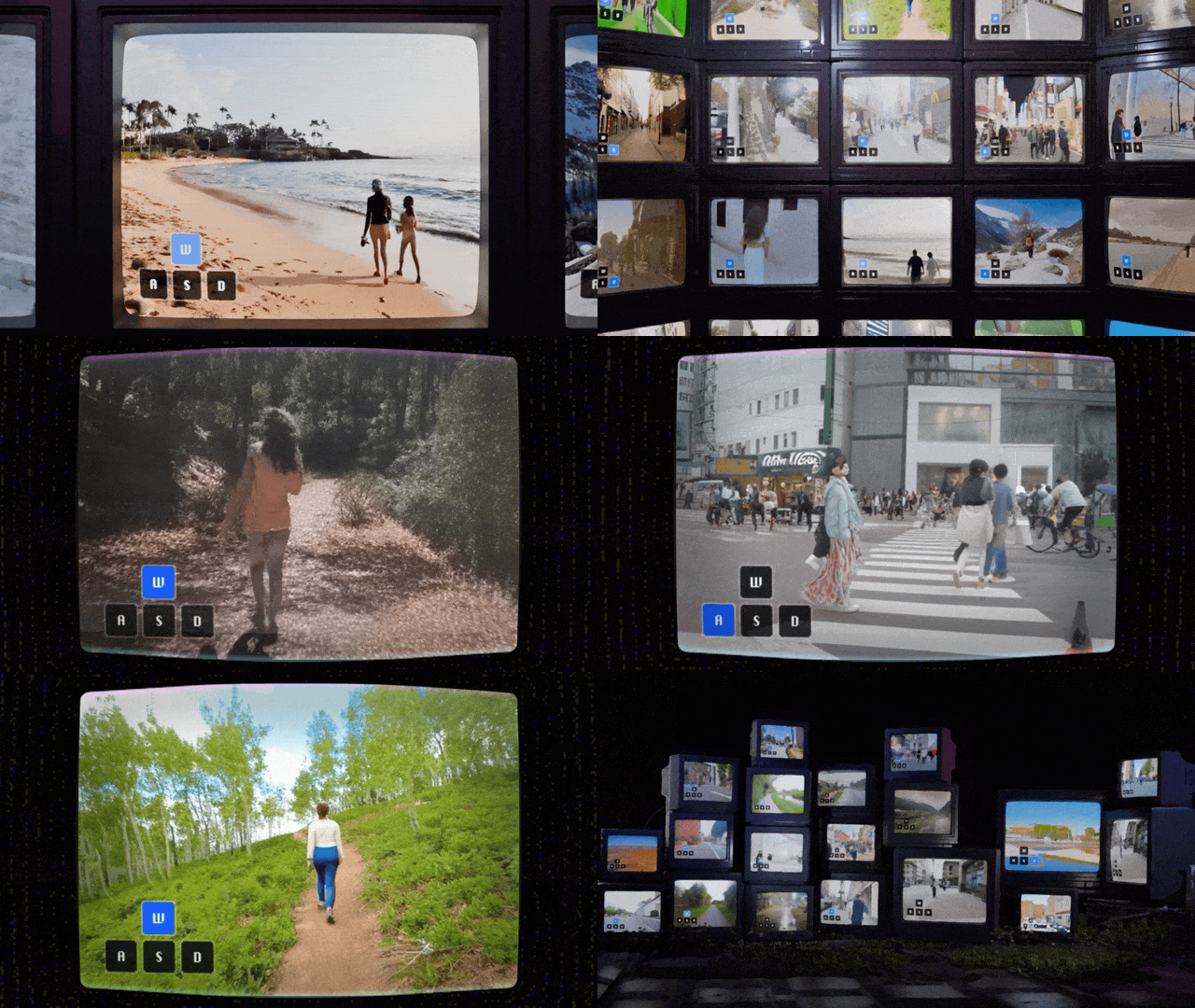
Research on interactive video is early, and many labs have focused on learning visuals and actions from game worlds like Minecraft or Quake. At Odyssey—my startup—we’re teaching models to learn from real-life video. Because of this, our early outputs (which you can see above) feel eerily real, and like the very beginning of the Holodeck.
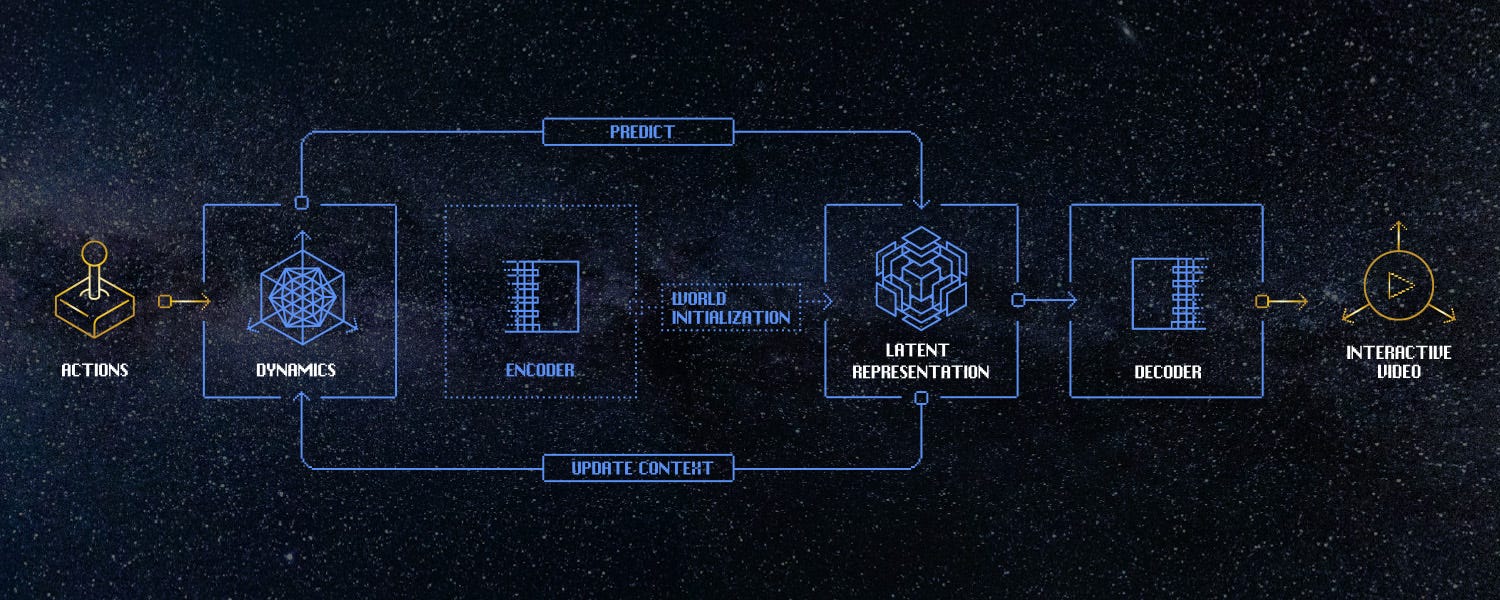
Every 33 milliseconds, this model imagines the next video frame influenced by a control (like pressing W to move forward), producing realistic visuals at 30 FPS without the need for any game engine or production time. There’s much to improve across visual quality, memory, consistency, and more, but the potential is clear to see.
From precomputed media to generative media
All media—film, television, ads, and games—rely on a precomputed production pipeline. Content is authored and rendered prior to distribution, and every viewer experiences the exact same fixed output. Even the most interactive video games are effectively exploring pre-produced, human-authored trees of content.
Interactive video is an entirely new paradigm, where content is not authored in advance, but rather imagined in the moment. Each frame of video is generated and streamed live—based on the user’s input—with context and history fed into the model to maintain visual consistency. This shift—from pre-authored content to real-time generated—has the potential to unlock entirely new types of experiences. Content suddenly becomes hyper-personalized, continuous, and non-repetitive. The user is no longer a passive viewer, instead becoming a participant in the generative loop.
Production costs shift to compute
The legacy media pipeline is labor-intensive and capital-heavy, holding back what’s possible. High-end films and AAA games frequently exceed $100 million in production budgets, with painful, multi-year development cycles. These costs are largely due to manual workflows, like storyboarding, scripting, animation, modeling, compositing, editing, rendering, marketing, and much more.
Interactive video totally inverts the cost structure of content production. Once a model is trained—which can be done for far less than a single traditional high-end film or game—the cost of creating any type of content becomes simply a function of inference (or compute time) cost. Today, this cost is fast approaching $1 per hour of content generated, and looks set to continue to decline as hardware efficiency and model optimization advances. Compared to traditional film and game production, this cost is revolutionary. Rather than building a single piece of mass media for millions of users, it suddenly becomes viable to deliver bespoke, hyper-personalized interactive content to everyone.
Natively supporting all levels of interaction
Legacy media formats determine a fixed level of interaction upfront, and restrict how the audience can interact with each piece of content. Film and television are locked to passive consumption, while games require constant interaction.
Interactive video removes this constraint. Because content is generated in real-time (in response to some or no user input), the model can fluidly accommodate both passive and active participation. A viewer may choose to simply watch a story unfold in front of them. But at any moment, they can engage with an input (via keyboard, controller, touch, voice, etc.) and influence the content and story as it’s generated. This shift enables a continuous spectrum of engagement. Media can seamlessly adapt to the viewer’s device or attention—shifting between consumption and interaction.

The emergence of a new form of media
Traditional film and games will continue to shape culture with incredible stories and evolve in their own ways, but consumers will soon have new ways to have fun, be inspired, and to learn—like interactive video.
Interactive video opens the door to an entirely new form of media, where stories can be generated and explored on demand, free from the constraints and costs of traditional production. Over time, I believe most everything that is video today—games, films, ads, education, training, travel, and more—will be a great fit for interactive video. I’m excited that Odyssey is leading the way on this, pushing the frontier alongside AI labs like DeepMind, Microsoft, Decart, and more.
I bet you sleep like a baby, don't you?